Posted in The Saga of Sonnystone Acres

Part 2 – First Family: The Millers

As noted in Part 1 of this series, Jacob and Maria/Mary Miller were the first folks to build a home here on the land we’ve named Sonnystone Acres.

Jacob Miller was born 1812 in the Electorate of Hessia.  It’s unclear when he came over from Germany and finding a Jacob Miller/Muller/Mueller in the plethora of German immigrants who swarmed into Vanderburgh County in those days is like finding a needle in a haystack.

What’s certain is this particular Jacob Miller was 26-years-old when he married Maria Klein in 1838.  He bought his first 20 acres of land in Center Township in 1840 and opened a blacksmith shop, one of many in Mechanicsville,  on the north corner of Sonnystone, near the State Road (now Stringtown Road).  Just up the hill, they built the original Sonnystone house, and the hand hewn logs that Jacob placed as a foundation are still there.

All five of the Miller Children were born here, every two years from 1840 until 1848. Henry was the oldest, followed by Conrad, John, Jacob Jr. and Mary. The children grew up helping on the farm, and enjoying the close community. They attended church and were educated in the schools of the time, likely down the road at Old North Chapel (built in 1832). None of the children followed their father into blacksmithing, however.

During the 20 years that the children grew up here, Mechanicsburg was a close community, but the population was dwindling and many businesses were relocating. After their son, John, died in 1860, the family sold their farm and Jacob, Sr. moved his blacksmith shop south of Pigeon Creek (in the area where Cedar Hall School sits today) closer to downtown Evansville, where his sons were working.

Oldest son Henry was working as a Post Office clerk in 1860, living down near the Ohio River. Conrad and Jacob, Jr. were working as sales clerks at a downtown dry goods establishment

When the Civil War started, Henry found work on the steamboats and was a  Union Army Captain by the end of the war.  I have record of Jacob, Jr. serving in the 136th Regiment of Indiana Volunteer Infantry, but none of Conrad’s service. The family actually prospered during the War years, as Evansville was a busy port, and Conrad and Jacob,Jr. were learning the business of dry goods. Sadly, Henry died in 1868, leaving behind a wife and three daughters.

By 1870 Jacob,Sr. had retired from the smithy and the couple were living with Conrad and Jacob Jr., all of them rather wealthy according to the census. 

In 1871, the two surviving Miller sons, who had grown up here on the farm, established a business together: Miller Brothers Dry Goods. Maria and Jacob must have been very proud of their sons! While I’m not certain, I believe their daughter married well and was living nearby when Maria passed in 1879, and Jacob, Sr. died in 1883.

In 1885 the Miller Brothers erected a building on Main Street that was the Largest dry goods store in the state at the time and for many years thereafter.

In 1886, Conrad withdrew from the business and moved to Boston and engaged in the same sort of business, becoming a successful merchant there. After Conrad left Miller Bros. Jacob joined in with W.S. Gilbert and the name of the business became Gilbert-Miller Dry Goods.
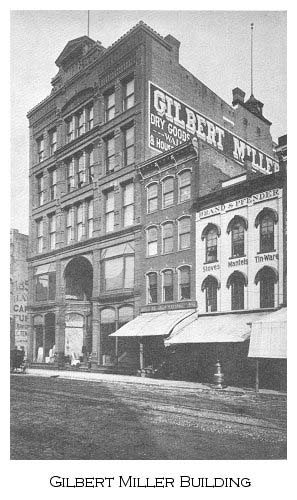
Jacob, Jr. never married, but has a lengthy biography in the aforementioned “History of Vanderburgh County” (1889) that gushes over his character and accomplishments. He served for a year in the Civil War, and was also a city councilman for several years.

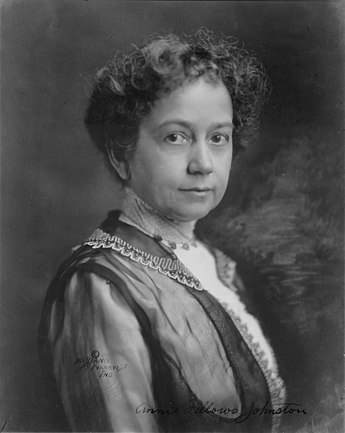
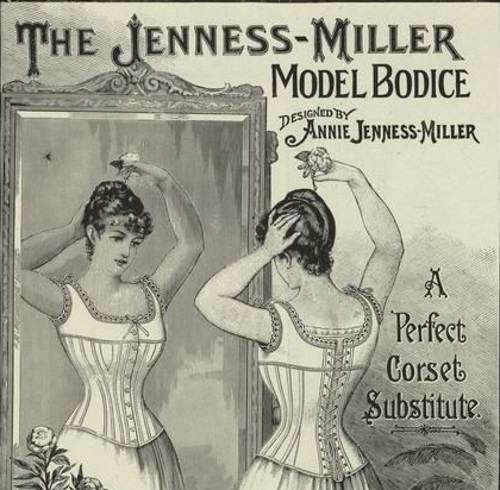
In the meantime (1887), Conrad, age 45 and now living in Boston, MA,  married Anna “Annie” Jenness who is a famous lady that I’d  never heard of.  She was a “dress reformer” and I find her a fascinating figure, though only tangentially related to Sonnystone…

From Wikipedia:  Anna “Annie” Jenness Miller (January 28, 1859—August 1935) was a pioneering clothing designer and an advocate for dress reform, as well as an author and lecturer.  She basically loosened the corsets and invented “leglets” for women, making it easier for them to ride bicycles.  I think we call them pants today.    She was really cool, a member of the Massachusetts Women of Letters alongside the likes of Louisa May Alcott, Julia Ward Howe, Lucy Stone — and all of that was before she married Conrad (17 years her senior) at age 28.  You can read more about here here.


During the 20 years that the Millers lived at Sonnystone the area had faltered commercially.  Evansville’s population, which had declined between 1840 and 1850 to only 3,235, surged to 11,484 in 1860 and businesses there were growing strong.  The areas around Sonnystone –Stringtown, Mechanicsville, Kratzville, and McCutchanville — were mostly farms.

John Reed bought the estate from the Millers in 1860 and he and his family farmed here for 63 years.

The Reeds have a convoluted, rather scandalous, story to tell…

Stay Tuned…


Posted in 2020, Genealogy of Sonnystone Acres

Sonnystone Saga: Before and After

To celebrate 17 years living at Sonnystone Acres, we are publishing a series of posts chronicling the first three families who lived here, spanning 111 years…

This is the fourteenth and final installment of the series…

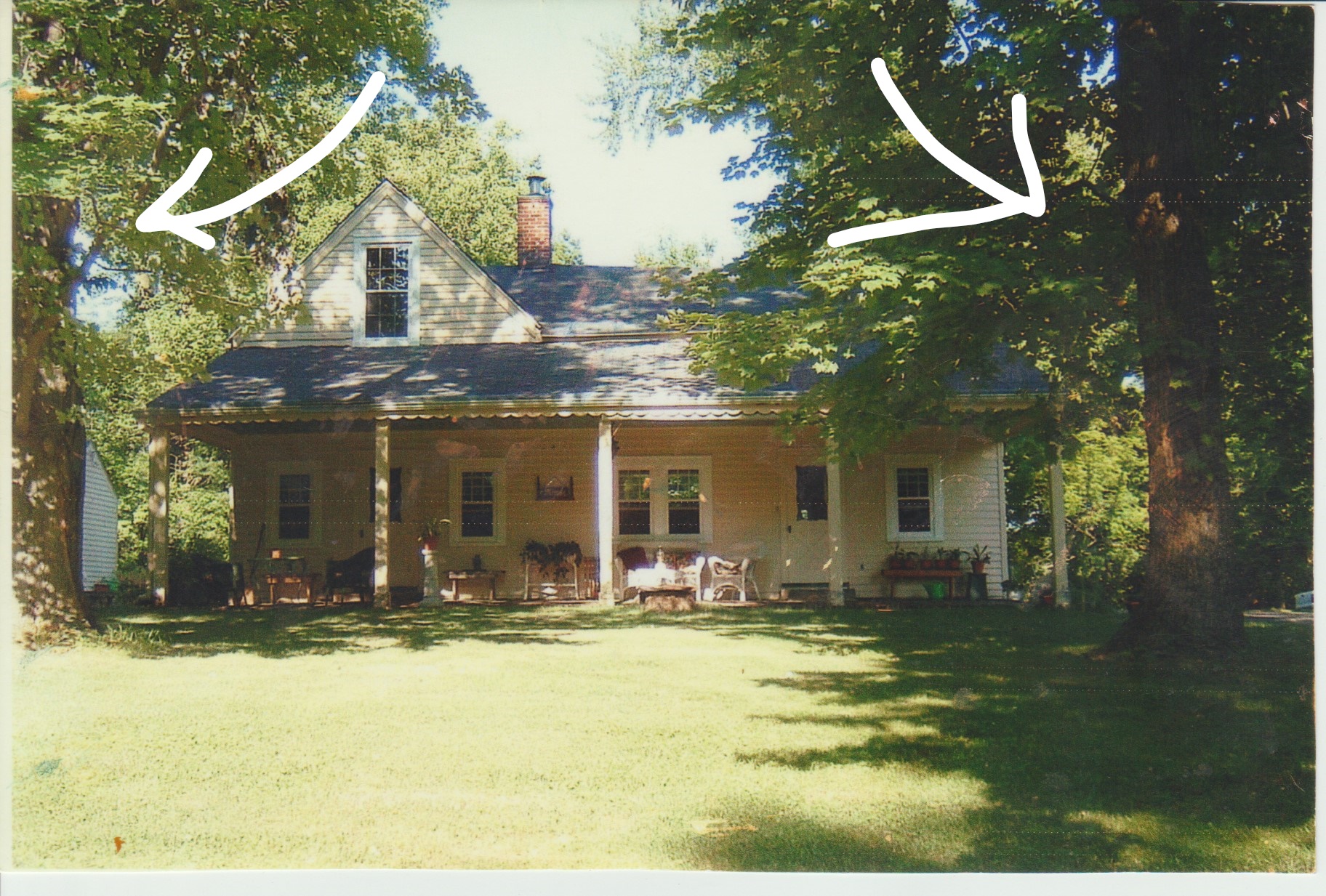
When we moved in, the house was clapboard with old crank-out windows that were covered with sheets of plastic.  The fireplaces were covered and sealed with wood.  It was drafty and old Mr. Casler, who was a math professor at UE, had pushed old mimeographed test papers into the gaps in the windows.  The radiator-heating worked fine, but it needed a boost, so we put a woodburner in the front fireplace and a gas stove in the back the first winter, but our utility bills were outrageous until the following year when we put in new windows and siding.

This slideshow requires JavaScript.

The laundry room is in the old garage that we call the Shed (we added a Real garage later), about 15 feet from our kitchen door.  We brainstormed for years to figure out how to connect them, finally arriving at a solution just three years ago…  It is now a fully enclosed covered room that connects the two buildings.

Walkway between house and laundry room/shed

—————————————————————————————————————–

The Big Tree in front of the south porch, where the Bird/Peace Garden is now, was a Big reason I fell in love with this house.  It was huge, seriously huge, and the first year we had a family of raccoons that lived in a hollow at its base; the babies were darling, but Casey moved them on.  After a few year, a monstrous branch fell — I can’t find the picture, but it was nearly as tall as I am — and I began to see that if I didn’t remove it, it would surely fall on my house.  I’m talking Large Tree that gave shade all the way over the house to the area where the pool is now.  It killed me (and my pocketbook) to have a crane come in and take it down.

It was a good move, though.  Just three years later 70mph straight-line winds blew in and felled the two large trees that were in the front.  They grazed our porch and took out part of the original garage roof where the pool is now.  I think the Huge tree would have smashed our whole house if it had still been standing.

the trees that fell

The hostas and ferns became a thing of the past…it’s all full sun now…and that’s why we screened in the front porch…

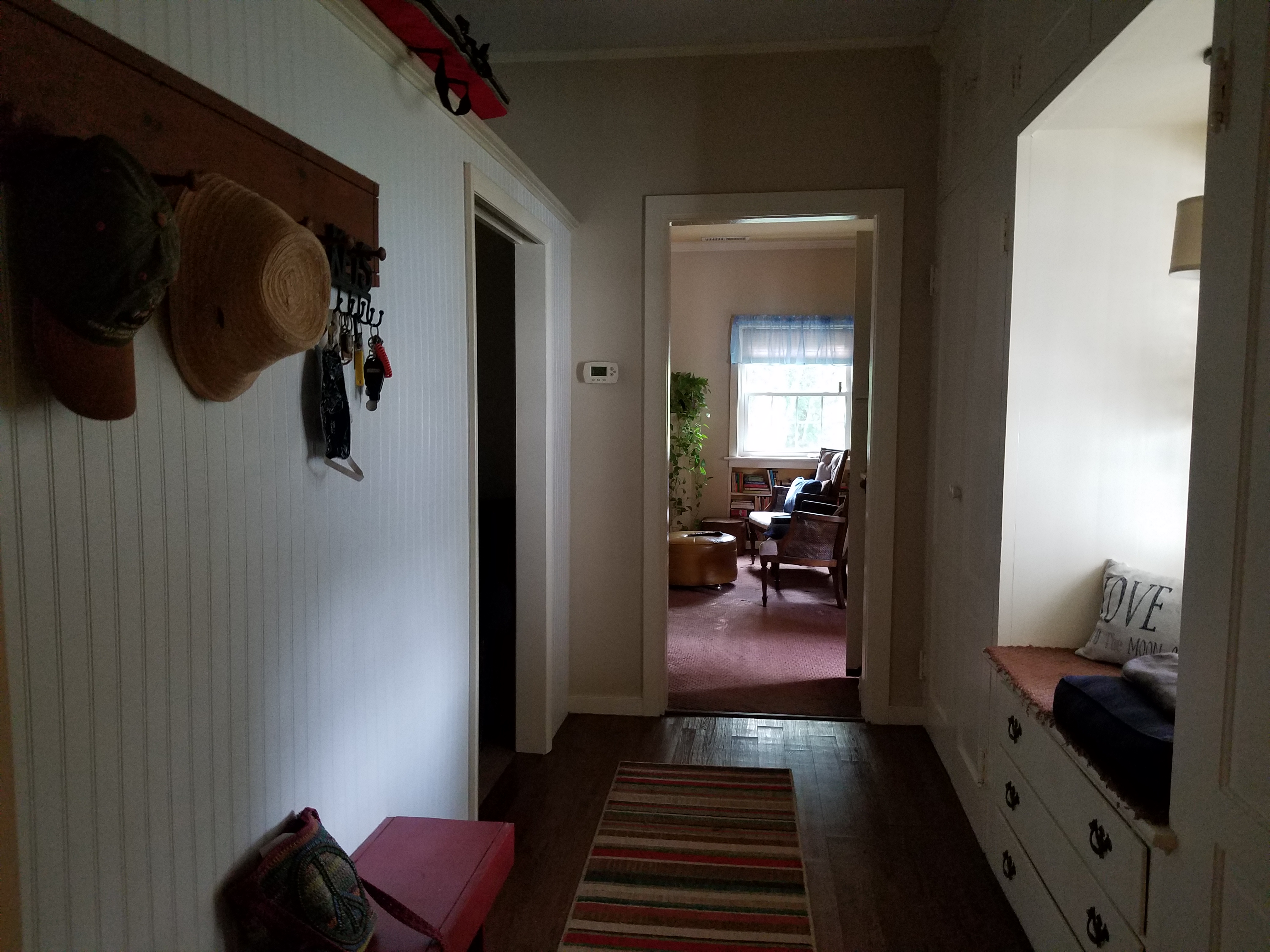
Over the last 17 years, the interior has been painted and carpeted a couple of times, different furniture, different arrangements.  I took very few before pictures…no phone cameras back then.  All of these “before” pictures were taken the day we first viewed the home and show the Casler’s decor…

We use the back “bedroom” as a family room…

There was a Lot of wallpaper…  We painted the cabinets 4-5 years after we moved in… I’m ready to repaint them now…this winter…

The middle room that was used as a bedroom was open to the back door–I mean, you walk in and there’s my bed and you had to walk through my bedroom to get to the fam room…  That had to change.  We put up a half-wall and made an entry area and a cozy bedroom…

The entryway formed by the half-wall changed the shotgun-house effect…

There is an entire upstairs, but we do not have “before” pictures.  It’s a cool area with two bedrooms and a full bath that features a clawfoot tub.  We’ve done work up there, but it doesn’t really show…

Some oddities:

The weird door?   It’s very small, maybe original to the cabin, but the locks are…strange…

The trap shooter… There is a foundation behind it that we’re still exploring, possibly where the shooters stood?  It is all wooded now, just to make the study challenging…

It’s been fun writing this genealogy of our home and I thank you for following along.  It isn’t just my love of the house that has motivated all this work, but also my love of historical research.

The Investigations continue!  I’ll be writing stories about my Own Ancestors and others, posting them every Monday here at Sonnystone Acres.

Stay Tuned…

Posted in Genealogy of Sonnystone Acres

Sonnystone Saga: Mr. & Mrs. Smith, again…

To celebrate 17 years living at Sonnystone Acres, we are publishing a series of posts chronicling the first three families who lived here, spanning 111 years… This is the thirteenth installment of the series.

My visit to Willard Library produced a plethora of information.  I was looking for the obits of George D., Albion, and George B. Smith, but was unable to find young George’s.  What I did find filled in quite a few gaps of the years and corrected some of my assumptions.

After little Georgie’s death in 1926, the Smiths returned to Evansville and retreated to their country home.  1927 was the first year that the city directory listed their residence as “Stringtown Rd 5 miles out”; prior to then, their address was on Riverside Dr.  I speculate that they kept a place “in town”, though, since George owned the apartment building and still worked at his father-in-law’s store.

What I found on George Davis Smith was not an actual obituary…it was Front Page Lead Story…!!

You couldn’t have any easier research than that. The article is a long one, continued on p. 7 with a picture.   It covers his early life and is essentially the same info I gave you in my last post (Here) .  It does not mention the loss of little Georgie in 1926, but fills in the years after that.

In 1929, the H.E. Bacon Department Store was sold to Woolworths,  after which George and Albion spent about six months in California.   According to the 1930 census, George and Albion, now 44 and 38 respectively, are living here at Sonnystone and George is retired…but not for long.

In late 1930, George joined Harris Upham’s newly-formed Evansville branch and became its manager in 1933.  The brokerage firm had sensational growth under Smith’s management.

A lot of column inches are devoted to stories of George’s pranks…yes, he was an inveterate practical joker, often referred to as “Jokesmith”.  I abhor practical jokes, seriously avoid practical jokers, (even George Clooney) and did not find any of the pranks the least bit funny, though the writer of the article seems to have been very amused.  They were quite elaborate and there were retaliations, so the stunts went on and on.  Not funny to me, but he seems to have been very popular among Eville’s prominent businessmen.

After we started clearing off the back acres here at Sonnystone we came across a slab of concrete with a rusty skeet trap attached.  A skeet trap throws clay pigeons up in the air and shooters try to break them before they fall.  There were more of them scattered around the 20 acres that the Smiths owned.  George was an expert shot and one afternoon at a trap-shooting match with a party of friends here at Sonnystone, he played one of his practical jokes.  While everyone was breaking targets, one fellow, usually a good shot, couldn’t hit the side of a barn.  Later on he found out that George had given instructions that every time it was that guy’s turn they threw aluminum pigeons instead of clay.  very funny…ha ha ha…

But it tells me what Sonnystone was like in those days.  An avid duck and quail hunter, George kept a kennel of fine hunting dogs here.  Between duck and quail season, he hunted possums and coons at night.

Oddly enough for a duck hunter, George loved birds.  He built trail of bird feeding stations around the property and kept them filled with food for his feathered friends.

But what of Albion Smith? Her mother, Albion Fellows Bacon, died in 1933, suddenly of a heart attack.  Her obituary was a mile long, as was the viewing line at the funeral. Shortly after, her father, H.E. Bacon, who was in ill health. moved to Baltimore to live with son, Hilary, Jr., a doctor at Johns Hopkins.  He died there in 1936.

Mrs. Smith’s  obituary was much more cut and dry, but still filled in some gaps.

Quoting from the obit:  “Known as an authority on antique furniture, she had operated a shop in her home at (our address) Stringtown Road.” Later on in the obit: “She was considered an authority on period furniture and her home on Stringtown Road lent itself to the display of the furniture.  She found it simpler and easier to store and sell prints and eventually devoted her time to them.”

So which part of the house “lent itself to the display of furniture”?  It’s a mystery to me, as this house is Not Fancy.  There is no fine woodwork or trims, no classic columns or stairways; it’s a plain country house.  Albion had been raised in opulent Victorian and Edwardian homes and may have even started her shop selling her mother’s furniture, so how this house “lent itself” to display of anything other than primitive or shaker pieces is a mystery…one I continue to investigate.

George and Albion both served on various boards around the city, but were not particularly known for philanthropy and were decidedly not social activists.  They traveled broadly, according to both obits, visiting Europe and Northern Africa.  They spent time in Michigan with Albion’s sister, Joy, and in Maryland with her brother, Hilary.

One story is very telling about the Smiths:  George’s work at Harris Upham was so good that he was offered a promotion to managing the Indianapolis office, the next step on his way to the top.

As the article puts it: “It was a flattering offer, not to be scorned, but sitting on the lawn of his home, surrounded by his dogs, his ears filled with the music of the birds, he decided to reject the offer.  He explained to Mrs. Smith, “What I have here I could never find any other place in the world.”

That’s the way I feel about this place, too.  I knew from the minute I saw it that I had to live here.  I could tell that the house and grounds had been cared for and loved, then let go.  As we’ve done the “archaeology” and discovered areas that appear to have been gardens, spots where it looked like someone kept dogs, and uncovered stone walks that lead to nowhere, I’ve felt the presence of Albion and George urging me to fix it up, make it pretty, invite the birds, and be content.

George Smith died in 1955 and Albion sold the home two years later.  She divided up the 20 acres into parcels, leaving the house with four.  She moved to a home on E. Gum in Evansville.  In 1961 she became ill and went to live with her sister, Joy, in Michigan; she died there in 1962.  She and her two Georges are buried in Oak Hill Cemetery, a spot on my to-visit list.

Having spent her life overshadowed by her famous mother, and having an even more-famous author aunt, I wondered if Mrs. Smith’s obit would also prominently speak of them.  Interestingly, it only gives her mother a line, but devotes an entire paragraph to her Aunt Annie. Her obit does not mention the birth and death of her son, the most important part of her story.

After the Smiths, no family lived here more than four years until 1970 when Max and Candace Casler bought the house.  The Caslers stayed until Max’s death in 2003.  Sadly, the Caslers let the place go downhill during their 33-year tenure.  Next week, I’ll show you some more “before and after” pictures.

Stay tuned…

Posted in Genealogy of Sonnystone Acres

Sonnystone Saga: Sisters again…

To celebrate 17 years living at Sonnystone Acres, we are publishing a series of posts chronicling the first three families who lived here, spanning 111 years… This is the eleventh installment of the series…

The Evansville Journal reported the 10/11/1888 double wedding of Annie Fellows and Will Johnston/Albion Fellows and Hilary Bacon in great detail the next day.  “It is quite an unusual thing to witness double marriages, which fact, with the prominence and standing of the parties made the affair doubly interesting.”  Trinity Methodist was filled to standing room only.  Annie and Albion wore heavily embroidered China silk; Hilary, Will, and the ushers wore traditional black.  The Journal sums it up:  “The parties are well-known in Evansville and will receive the warm congratulations of many friends.” 

Married life in the Gilded Age came with the expectation that the wife would not work outside the home.  Albion settled into a home just doors from from where she had lived with her Igleheart relatives. She wrote later that “my husband, housekeeping, flowers, reading, music, my friends, and a pleasant social round filled up the hours.”

Her sister lived a five minute walk away –where the Penny Lane Coffee House is today.  Annie married a ready-made family; her step-children were 16, 10, and 7. When their mother died in 1883, Will had sent them to live with wealthy relatives of their mother in Pewee Valley, Kentucky, just east of Louisville.  They were thrilled to return to live in Evansville with their father and new step-mother, but considered Pewee Valley paradise and continued to spend their summers there.

Albion, though, had to start her family from scratch and she wasted no time about it.  In September, 1889, Albion gave birth to her first child, a daughter she named Margaret Erskine.  She was delighted.  Hilary’s business, now Lahr-Bacon Department Store, was booming.

Things weren’t going as well with Annie, unfortunately.  Will suffered from consumption (tuberculosis) and in 1890 his health declined dramatically.  By June, 1891, he applied for and received a Civil War Pension.  Annie struggled to keep the bills paid and care for her invalid husband on the meager pension.

Albion was as concerned as any close sister would be, but she was pregnant with her second child.  She gave birth to another daughter, Albion Mary, on January 4, 1892.  Annie’s husband, Will Johnston, died a month later on February 8, 1892.

Annie received a Civil War Widow pension, but the economics looked pretty grim.  Her oldest step-daughter, Mary, 20, had returned to Pewee Valley, but Annie wanted to keep the younger children, Rena, 14, and John, 11, with her in their home in Evansville.  In order to make ends meet, she tutored, did typing, submitted poems and stories to magazines,…and she began to write children’s books.

Just down the street, Albion was suffering from what in these days we call post-partum depression, back then called “nervous prostration”.  The books I’ve researched are old and take a great deal of time debating whether her depression was caused by the “stifling of her creative outlets” caused by the rigidity of The Gilded Age.  If it weren’t for the proximity to her sister’s plight and the birth of her second baby, I might buy that.  Given her independence and smarts, she would never have been happy just going to teas, but from her own description it sounds like deep post-partum depression and thank goodness today we understand it better and are able to help more.

She writes about it in her autobiography, “Beauty for Ashes”:

There was one long while where I could not hold them (her daughters) in my arms.  The house was hushed and darkened, and the servants went around with noiseless steps.  For months I was very ill.  Then, for nearly a year, I dragged about white and thin…weary, listless, indifferent, with no special interest in anything but my family…For hours I would sit idly, not making an effort even to read… It seemed as if the wheels of life had suddenly stopped…It was two years before I took any interest in people, two more before the shadow of the eclipse had moved off my world. It was eight years at least before all my energy and enthusiasm and joy of living returned.”

Meanwhile, Annie had her first book published in 1893.  “Big Brother” sold few copies, though.  In 1894, she won $1000.00 in a contest for the story “Joel: A Boy of Galilee”, which encouraged her.  She, Rena, and John frequently visited the children’s aunt and uncle, and cousin, Hallie, at their estate in Pewee Valley.  Annie was inspired to write a book based on Hallie.  She called it “The Little Colonel” and it was loosely based on the family, their servants, and the community.  In 1896, Annie sent off her manuscript to a new publishing house, L.C. Page in Boston, MA.  The editors began the back and forth, but there was no money exchanged.

Annie Fellows Johnston writes in her autobiography, “The Land of the Little Colonel”:

“In September, 1897, we came to a turn in the road where we could only see one step ahead at a time.  Rena joined Mary in Pewee Valley; I sold or stored our household goods and took John up to Highland Park to put him in the military school there.”

Annie took a position as a companion/governess/chaperone for a young lady, traveling for three months in Europe.  By the time she returned, “The Little Colonel” had been published and was a phenomenal success.  She moved to Pewee Valley, where she followed up her success with more success, and The Little Colonel Series eventually comprised 13 books and other merchandise, including a 1935 movie starring Shirley Temple.

I Really Love Annie, Really Really…

As Albion was coming out of her depression, Annie spent time with her compiling a book of poems they had written when they were growing up in McCutchanville.  “Songs of Ysame” was published in 1897.  That same year, Albion and Hilary moved into a their newly-built home at 1021 SE Second Street.  She joined The Women’s Foreign Missionary Society at Trinity Methodist and returned to involvement in the Ladies Aid there.  A Calendar of Events in Evansville, 1898, included two poems each by Albion and Allie.  Slowly, she was coming back to Life and when she finally began to paint again in 1899, she felt truly healed.

In 1901, Albion gave birth to twins: Joy and Hilary, Jr.  Margaret was 12 and Albion jr was 9.  The Bacons were quite rich.  Albion had two nannies for the twins, a housekeeper, cook, and gardener.  She lived in a beautiful home on a street full of beautiful homes.  She was totally unaware of anything but the life of privilege for many years, but that began to change.

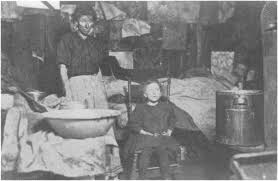
Albion Fellows Bacon tells the story of how she “woke up” in her beautifully written autobiography “Beauty for Ashes”, which I urge you to read.  For purposes of brevity, I will sum it up thusly:  Realizing the plight of poor people, she especially noted that their living conditions were abominations.

Believing that substandard housing was the root of urban social problems, she tried to pass regulations to improve Evansville tenements, but failed.  She changed her tactics and began to lobby at the State level, with her goal to pass a statewide housing law.  She worked with a national group to draft legislation which was sponsored by the Indianapolis Commercial Club in return for her work lobbying the state legislature.  She attended every session of the Indiana General Assembly from 1909 to 1917!  As a result, housing reform bills were passed in Indiana in 1909, 1913, and 1917.  The 1917 housing reform bill was passed unanimously.  Albion wrote pamphlets and books on tenement reform throughout those years.

Albion’s daughter, Margaret, had died in 1909, just 20-years-old, while away at college.  It was a blow, but she persisted in her passion.  She writes that she always made family her top priority, taking her children along when she traveled to Indianapolis for the legislature sessions and when she traveled to speak at various clubs and organizations around the country.  Hilary became involved with local philanthropic causes in Evansville and was a strong support for his wife’s efforts.

I wonder what it was like to be the daughter and niece of such dynamic women–and to carry your mother’s name, no less.

Stay tuned…