Posted in The Saga of Sonnystone Acres

Sonnystone Saga, Part Fini

 We are now on Part 6 of The Sonnystone Saga, the genealogy of our Old House. Here are the links to Part 1 and Part 2 and Part 3 and Part 4 and Part 5 in case you missed them. The Reed Family lived here for 60 years and it’s been a real romp re-posting their stories. I’m now ready to return to our normal programming, so don’t forget to stop by on Sunday to catch the latest news.

The Reeds: Coda

Minnie Reed Olmsted took possession of her family home, now known as Sonnystone Acres, in 1908 upon the death of her mother, Mary Inwood Reed. Mary was the last surviving child of pioneers William and Hannah Inwood, a family that had been integral to the British Settlement established in 1819. I have loved stalking the Inwoods…especially Uncle John and his kids…

In 1910, Minnie Reed Olmsted, 52, and her husband, Goodrich, 60, were living here at the Acres with a “boarder”, William Harper, 14. I believe he helped out on the farm, as their occupation was truck farming. Their oldest daughter, Emma, had married in 1906 and moved to New Albany, IN. Daughter Mary Ella, had married in 1908, and she and her husband, Oscar Hanning, owned a dairy farm on nearby Kratzville Road.

Minnie and Goodrich Olmsted…

Ada Reed Van Dusen, 50, and her husband, Louis, 52, were also empty nesters. Their daughter, Mary Irene, had married in 1901. Her husband was a butcher by the name of Louis Yokel. By 1910 Yokel had opened his own grocery and meat shop on the corner of Main and 7th streets, named Yokel and Sons. The family still lived on Stringtown Road, though, in a house across from present-day Old North UMC that we Almost bought just before we found Sonnystone. Coincidentally, I got to know Mary Irene’s daughter, Marjorie Yokel Copeland, and her grand-daughter, Carol Stremming, when I was attending Old North back in the 80s…

Sometime around 1910, Minnie’s son, Charles Elston Olmsted, and her sister Ada’s son, LeRoy Reed Van Dusen, set out for the West where they bought a farm/ranch in Prairie Springs, Idaho. Cousins! How adventurous!

As for the other Reeds in 1910, Thomas, 64, is still a drayman, still on Goodsell Street with a houseful. Living with him are his sons Harry and Inwood, Harry’s wife and three children, and his daughter, Sadie.

Jack Reed, now 68, is living out on Darmstadt Rd, boarding with Fred and Mary Kaiser. His occupation is “own account” which means he works for himself or has an independent income.

George Childs, 63, was the Postmaster of Chandler in 1910, where he and his wife, Anna, the schoolteacher, resided. Their son, Leslie, still lived with them and his occupation is listed as “gold miner”… Seriously. More likely, he was a coal miner.

Louis Van Dusen died in 1917 and Goodrich Olmstead died six months later in 1918. Per the 1920 census, the two widowed sisters, Minnie, 62, and Ada, 60, were living together here at Sonnystone. They list their occupation as truck farmers…always…

I can’t find a record of the death of Jack Reed, but according to my abstract he died around 1921. I’m not surprised that he wasn’t buried in the family plot. George Childs died in 1923 and he was interred with the rest of the family in Salem Cemetery.

In 1923, Minnie sold the farm and she and Ada Belle moved down the road to the old Van Dusen home. Minnie died in 1929 and her death certificate says that the coroner “took her remains” for an inquest. That would mean, I think, that she had died unexpectedly, perhaps in her sleep. It says he came to the scene at 7:30 a.m. and that the informant was Ada Van Dusen. Cause of death was “coronary lesion” — heart attack.

Ada Reed Van Dusen was the last survivor of the Reedmont days, living until 1943. She died at Regina Pacis Nursing Home.

In 1923, Sonnystone was given fresh life. The New Owners were George Davis Smith and his wife, Albion Bacon Smith. The Smiths placed the “S” on the chimney that inspired me to name the place Sonnystone Acres. They are responsible for the east addition and the garage-without-a-driveway, as well as the leftover kennel pens and the skeet-shooter hidden by brush on the edge of the woods. George and Albion were members of Elite Evansville Society, third-generation wealth.

Their fascinating family stories will take us back to the pioneer days of the British Settlement around McCutchanville and Mechanicsville again, but this time we’ll visit the bustling metropolis of Evansville before we return to “Stringtown Rd. 5 miles out”…

Stay Tuned…

Posted in The Saga of Sonnystone Acres

Sonnystone Saga – Part 4

 We are now on Part 4 of The Sonnystone Saga, the genealogy of our Old House. Here are the links to Part 1 and Part 2 and Part 3 in case you missed them. The Reed Family lived here for 60 years and require four separate posts to tell their story. It’s a real page-turner, so I hope that you will watch for the next installments to be posted on Wednesdays and Sundays.

Reedmont 1870-1888

When the enumerators returned to Reedmont, aka Sonnystone Acres, in 1870, John, now 54 years old, and Mary, 47, still had four of their children living with them:  Sarah Childs, 27; George Childs, 23; Minnie, 14; Ada, 12.

By the time of the 1870 census, Jack Reed was 28 years old and married to Jane Sutton.  His occupation is listed as “laborer” and he owns his own home in Evansville valued at $1100 with personal property $200.  Living with him are his father-in-law, William Sutton, a laborer, and his brother-in-law, Joseph Sutton, an insurance clerk.  Mr. Sutton and his family had arrived from England in 1853 when Jane was 11 years old.

John’s ex-wife, Sarah Inwood  Green, 50,  was living with her sons, William, 15, and Benjamin, 13, in downtown Evansville near the home of her brother, William.  She says she is a widow, keeping house.

Regarding the rest of the Inwood siblings, John had retired from farming and was also living in downtown Evansville.  John evidently thought a lot of the Reeds, as he named one of his sons Thomas Reed Inwood…very confusing because he and Thomas Reed are nearly the same age.  Uncle George Inwood is still living on the farm nearby Reedmont and has a servant by the name of Anna Davidson living with him and his wife,

The decade of the 70’s brought many changes, particularly weddings…

Thomas got the ball rolling in 1873 when he married — get this– his cousin, Amelia Inwood, one of his Uncle John Inwood’s daughters!  So Thomas Reed and Thomas Reed Inwood were cousin/brothers-in-law…weird…

In 1874, George Childs, 27, married Anna Georgianna Davidson, 22.  Anna is the same servant who had been living with Uncle George Inwood, but she is subsequently listed as a schoolteacher.

Early in 1878, Uncle John Inwood died and was buried in the McCutchanville cemetery next to his wife, Harriett.

1878 saw the wedding of the youngest Reed, Ada, who was also called Belle.  She was 18 when she married Louis Van Dusen, 22.  Louis was the son of Martin Van Dusen, a wealthy farmer who lived in nearby Kratzville.  His mother was Abby Olmsted, daughter of Judge William Olmsted, one of Vanderburgh County’s first magistrates.  Judge Olmsted, who had come to Evansville in 1818 from Ridgefield, Connecticut, was not “learned in the law”, but he was scrupulously honest, unlike many judges at that time.  He was also County Commissioner and a well-respected public servant.

In 1879, Minnie Faye Reed married Charles Goodrich Olmsted, Jr., a cousin of Louis VanDusen,  and another grandson of Judge Olmsted.  His grandfather wasn’t his only claim to fame, though.  His father, Charles,Sr. was 37 years old with four children when he joined the Union Army in 1861.  He was captain of the 42nd Indiana Volunteers, and by all accounts an excellent leader.  He died at the head of his command at the Battle of Perryville, KY.  He was a Hero to the residents of Vanderburgh County.  His widow kept his farms in Mechanicsville near Reedmont and raised the children there.  Charles, Jr. went by the name “Goodrich”…

The Reed-Olmsted nuptials were held right here at Sonnystone…

From the Evansville Journal

In 1880 John Reed’s property was a compound of four families.  John and Mary Reed lived in Sonnystone house with George and Anna Childs and their son, John Reis Childs; next door were the Van Dusens, Ada and Louis, and their daughter, Mary Irene; next door to them were Goodrich and Minnie Olmstead who were newly-weds.  All the men were farmers and Anna is a schoolteacher.

Thomas and Amelia Reed, living on Goodsell Street in Evansville, had two sons by 1880, Harry, 4, and Benjamin, 11 months.   Thom’s sister-in-law/cousin, Mary Inwood, (daughter of the late John Inwood) was also living with them, working as a schoolteacher.

Where’s Jack?  In 1880 Jack was living with his cousin, James Inwood, son of the late Uncle John.  He was not listed as a cousin, however.  Instead, his relationship to James was “servant” and his occupation was listed as “servant/farm laborer.  Jack is divorced.  His ex-wife, Jane Sutton Reed, and his daughters, Alice and Mary, were living with her brother, Joseph, and his family.

Jack seems a little troubled, doesn’t he?  He probably blamed it on the divorce…  I have reason to believe that he didn’t get along well with his half-siblings…

Jack’s mother, Sarah Inwood Green,  ex-wife /sister-in-law of of John E. Reed,  died in 1884 and was buried in the Inwood family plot at McCutchanville Cemetery.  I continue to look for her sons, the Green boys, to no avail.

In 1886, George Inwood, Mary’s last surviving brother, sold his farm adjacent to Reedmont and moved with his family to Kansas.

John E. Reed died on January 14, 1888 at the age of 72.  He left a Last Will and Testament that is a doozey…  It sits prominently at the front of the Abstract of Sonnystone, so it caught my eye immediately as I started my research.  Anytime you end a Will with the warning that anyone who objects to it should be disinherited you figure you’ve got a Feuding Family…

Stay Tuned…


Posted in Sunday Report, The Saga of Sonnystone Acres

Wee Sunday Report & Part 3 of the Saga

My favorite plant store opened yesterday and I was first one there! I’ve bought tomatoes and sweet peppers to baby until it’s time to put them in the ground. I’m going back today to get more tomatoes, as I am going to do some experimenting this year with partial shade…

You’ll learn all about it in a couple of weeks when I start the garden blog, Growing Every Season.

We are now on Part 3 of The Sonnystone Saga, the genealogy of our Old House. Here are the links to Part 1 and Part 2 in case you missed them. The Reed Family lived here for 60 years and require four separate posts to tell their story. It’s a real page-turner, so I hope that you will watch for the next installments to be posted on Wednesdays and Sundays. I could have worked it into longer posts, but I’m too busy right now to do much more than a cursory edit.

I hope you enjoy the tale and that you’re also enjoying Spring as much as I am! If you need me, I’ll be out in the garden!!!

Meet the Reeds

After twenty years living here on Stringtown Road, Jacob and Maria Miller sold their property to one Mr. John L. Reed and his wife. Mr. Reed was born in England in 1815, but Try as I might, I find no record of his parents or when he arrived in the area. In those days, the village of McCutchanville, just three miles northeast of the Miller farm, was referred to as the British Community, so it seems logical a Brit arriving in the area would gravitate there.

I know much more about the background of his wife, as her parents were among the earliest settlers in Southern Indiana. William and Hanna Inwood were from Godalming, Surrey, England. When they arrived in the USA in 1821, they already had three children: Harriett, b. 1815; John, b. 1817; and Sarah, b. 1820; and three more were born after their move to Indiana:  Mary, b. 1823; George, b. 1826; and William, Jr. b. 1828.  The Inwood family settled land between Stringtown and McCutchanville along the state road, now Petersburg Road and became prominent citizens of the village community.

So it happened that in 1841, John Reed married Sarah Inwood, the daughter of William, Sr. and Hannah.  John and Sarah had three children together:  John “Jack”, b. 1842; Thomas, b. 1846; and Mary J., b. 1849.  The 1850 census shows that the family lives in Kratzville, a small community near Stringtown.  John was working for a trucking service as a drayman (driver of a beer truck). He owns real estate valued at $1100.  The kids were ages 7, 4, and 1.

Something very unexpected occurred between 1850 and 1860…John and Sarah Inwood Reed divorced.

Divorced?! you say, Divorced in the 1850’s?!  Unheard of.  I don’t have record of the actual divorce as those are hard to come by, but I discovered — to my amazement — that divorce was not as uncommon as I thought in those years.  In fact, Indiana had such lax divorce laws in the 1850s that coming to the state was a popular quick way to shed your spouse.

From “The Indiana Magazine of History” : [From 1852 ] until 1873, Indiana used to have one of the most liberal divorce laws in the country, and unhappily married individuals flocked to the Hoosier state in order to bring their unions to a quick—and relatively painless—end. According to Garber, in those days judges were inclined to grant a divorce decree “as a matter of course in every case where the defendant did not appear and oppose it.” The applicant had only to provide “proof of residence” and swear under oath that there was “statutory cause” for their petition.

Still, Divorce was considered quite scandalous in polite society… It appears that Sarah Inwood Reed was the first to stray which was even more sordid.   Sarah gave birth in 1856 to a son named William Green and in 1858 had another son, Benjamin Green.  I have no clue who their Daddy was, though I’ve looked everywhere for him.  The only candidate I’ve found would be a married man!  I’ve not ruled it out…

As if that weren’t scandalous enough, guess who John took up with and married? Sarah’s younger sister, Mary Inwood Childs! Mary had married Stephen Childs in 1842 and they had two children:  Sarah, (ironic that she named her daughter after her sister…) b. 1843; and George, b. 1847.. I do not see a record of Stephen Childs’ death — or his life, for that matter, other than the record of his marriage to Mary, but let’s just assume that he died since the children were always with Mary.

The situation caused great family dissension as well as scandal, so John and his new wife, Mary, moved to Richmond, Indiana around 1855 or 56 and lived there for the next four years. While there, they had two children, Minnie in 1857, and Ada Belle, born 1859. Mary’s children, Sarah and George were living with them, as well as John’s sons, Jack and Thomas, but their daughter disappears during that decade.

So it was that in 1860, John and Mary Inwood Reed returned to Center Township, Vanderburgh County. Post office of McCutchanville, and moved back into the bosom of Mary’s family.  They named their estate Reedmont.  Mary’s brother, John Inwood, and his family lived on the farm just south of them.  Her brother, George, lived two farms north.  Welcomed back into the fold?  By some, perhaps, but the Inwood family reunions must have been a bit awkward…

The family had moved in by the June, 1860 census and it shows that the property is valued at $2700, personal property $120.  They had a full house:  Sarah Childs, 17; George Childs, 13; Thomas Reed, 14; Minnie, 3; and Ada (Belle), 7 months.  Jack., 18, is also counted as living with them, working as a farmhand.

John’s ex-wife, Sarah Inwood Green. and her two sons, ages 5 and 3, were living with her youngest brother, William, a grocer who lived in downtown Evansville.  Guess who else is counted as living there in the 1860 census?  Her son with John Reed, Jack, is listed as a drayman. It would seem Jack went back and forth between his parents, a sign of things to come.

I can’t find a record of Jack serving in the Civil War, though he was just the “right” age for it.  Thomas Reed was only 15 in 1861 when the War started, but he managed to get in at the very end, joining the Indiana 42nd Regiment, Company A in February of 1864.  The 42nd met up with Sherman to fight the Battle of Jonesboro and were part of the March to the Sea and the Siege of Savannah.

By the end of the war, all were back home and the decade of the 1870’s was a bright one for most of the Family of Reedmont.

Stay Tuned…


Posted in The Saga of Sonnystone Acres

Part 2 – First Family: The Millers

As noted in Part 1 of this series, Jacob and Maria/Mary Miller were the first folks to build a home here on the land we’ve named Sonnystone Acres.

Jacob Miller was born 1812 in the Electorate of Hessia.  It’s unclear when he came over from Germany and finding a Jacob Miller/Muller/Mueller in the plethora of German immigrants who swarmed into Vanderburgh County in those days is like finding a needle in a haystack.

What’s certain is this particular Jacob Miller was 26-years-old when he married Maria Klein in 1838.  He bought his first 20 acres of land in Center Township in 1840 and opened a blacksmith shop, one of many in Mechanicsville,  on the north corner of Sonnystone, near the State Road (now Stringtown Road).  Just up the hill, they built the original Sonnystone house, and the hand hewn logs that Jacob placed as a foundation are still there.

All five of the Miller Children were born here, every two years from 1840 until 1848. Henry was the oldest, followed by Conrad, John, Jacob Jr. and Mary. The children grew up helping on the farm, and enjoying the close community. They attended church and were educated in the schools of the time, likely down the road at Old North Chapel (built in 1832). None of the children followed their father into blacksmithing, however.

During the 20 years that the children grew up here, Mechanicsburg was a close community, but the population was dwindling and many businesses were relocating. After their son, John, died in 1860, the family sold their farm and Jacob, Sr. moved his blacksmith shop south of Pigeon Creek (in the area where Cedar Hall School sits today) closer to downtown Evansville, where his sons were working.

Oldest son Henry was working as a Post Office clerk in 1860, living down near the Ohio River. Conrad and Jacob, Jr. were working as sales clerks at a downtown dry goods establishment

When the Civil War started, Henry found work on the steamboats and was a  Union Army Captain by the end of the war.  I have record of Jacob, Jr. serving in the 136th Regiment of Indiana Volunteer Infantry, but none of Conrad’s service. The family actually prospered during the War years, as Evansville was a busy port, and Conrad and Jacob,Jr. were learning the business of dry goods. Sadly, Henry died in 1868, leaving behind a wife and three daughters.

By 1870 Jacob,Sr. had retired from the smithy and the couple were living with Conrad and Jacob Jr., all of them rather wealthy according to the census. 

In 1871, the two surviving Miller sons, who had grown up here on the farm, established a business together: Miller Brothers Dry Goods. Maria and Jacob must have been very proud of their sons! While I’m not certain, I believe their daughter married well and was living nearby when Maria passed in 1879, and Jacob, Sr. died in 1883.

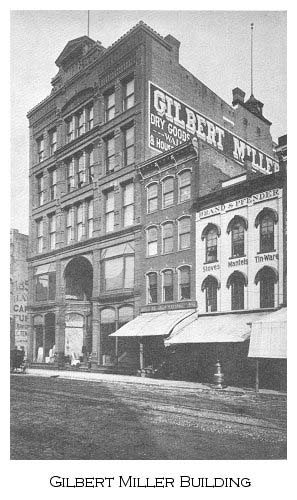
In 1885 the Miller Brothers erected a building on Main Street that was the Largest dry goods store in the state at the time and for many years thereafter.

In 1886, Conrad withdrew from the business and moved to Boston and engaged in the same sort of business, becoming a successful merchant there. After Conrad left Miller Bros. Jacob joined in with W.S. Gilbert and the name of the business became Gilbert-Miller Dry Goods.

Jacob, Jr. never married, but has a lengthy biography in the aforementioned “History of Vanderburgh County” (1889) that gushes over his character and accomplishments. He served for a year in the Civil War, and was also a city councilman for several years.

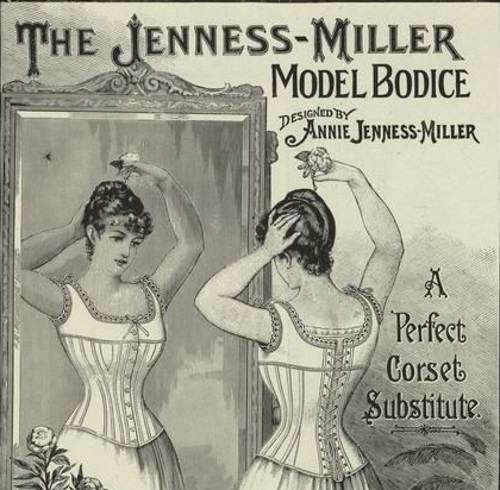
In the meantime (1887), Conrad, age 45 and now living in Boston, MA,  married Anna “Annie” Jenness who is a famous lady that I’d  never heard of.  She was a “dress reformer” and I find her a fascinating figure, though only tangentially related to Sonnystone…

From Wikipedia:  Anna “Annie” Jenness Miller (January 28, 1859—August 1935) was a pioneering clothing designer and an advocate for dress reform, as well as an author and lecturer.  She basically loosened the corsets and invented “leglets” for women, making it easier for them to ride bicycles.  I think we call them pants today.    She was really cool, a member of the Massachusetts Women of Letters alongside the likes of Louisa May Alcott, Julia Ward Howe, Lucy Stone — and all of that was before she married Conrad (17 years her senior) at age 28.  You can read more about here here.


During the 20 years that the Millers lived at Sonnystone the area had faltered commercially.  Evansville’s population, which had declined between 1840 and 1850 to only 3,235, surged to 11,484 in 1860 and businesses there were growing strong.  The areas around Sonnystone –Stringtown, Mechanicsville, Kratzville, and McCutchanville — were mostly farms.

John Reed bought the estate from the Millers in 1860 and he and his family farmed here for 63 years.

The Reeds have a convoluted, rather scandalous, story to tell…

Stay Tuned…